There is no catalogue at Albizzati Group. Every filter house, E-House, shelter, exchanger and power unit we deliver starts from the client’s specification and ends with a test that proves it meets it. Here is what customisation means in practice, phase by phase.
Why we do not sell standard products
A gas turbine filter house for a desert site and one for an offshore platform share a function, not a design. The same is true of a blast-resistant room for a refinery and one for an LNG plant, or of a command shelter for an expeditionary unit and one for a fixed installation. Dimensions, loads, materials, integrated systems and applicable standards change with every project. Trying to force these requirements into a standard product shifts the problem to the site, where adaptations are slow, expensive and risky. We prefer to absorb the complexity in the factory, where it can be engineered, controlled and tested.
What gets customised
Dimensions and structure
Overall dimensions of laboratories, refuges, E-Houses and PCM shelters are engineered per project. Our references range from local equipment rooms produced in series for a refinery to Field Auxiliary Rooms up to 67 metres long, and to single-piece modules of up to 580 tonnes. Structural design covers pressure, temperature, wind and snow loads and seismic actions for the actual site, with blast analysis where the risk assessment requires it.
Materials and protection
Carbon steel, stainless steel or aluminium for structures; carbon steel, 304 and 316L stainless, copper and brass or Duplex, Inconel and Hastelloy for heat exchangers; fire-rated and blast-resistant construction; EMI shielding, NBC filtration and pressurisation for defence shelters; painting cycles chosen for compatibility with the other equipment on site.
Integrated systems
What goes inside the module is defined with the client: MV/LV cabinets, MCC, UPS and batteries, DCS/ICSS, fibre optic cabinets, transformers and control consoles; HVAC and ventilation; fire and gas systems; PAGA, VHF radio and CCTV; operator stations and data management in command units. All of it is installed, cabled and tested before the module leaves the factory.
Configuration
Filter houses are supplied static or pulse-jet self-cleaning, with bag, compact and panel filter stages as required. Military shelters come in ISO 10′, 20′ or 40′ formats, fixed or expandable. Heat exchangers are configured by bundle type, baffles, tube layout and number of passes. The ERPT remote power turbine is offered in offshore, desert, Arctic and hybrid versions, and, as the original equipment manufacturer, Eudosia Sistemi can integrate the customer’s own equipment shelter with the unit.
How a requirement becomes a product
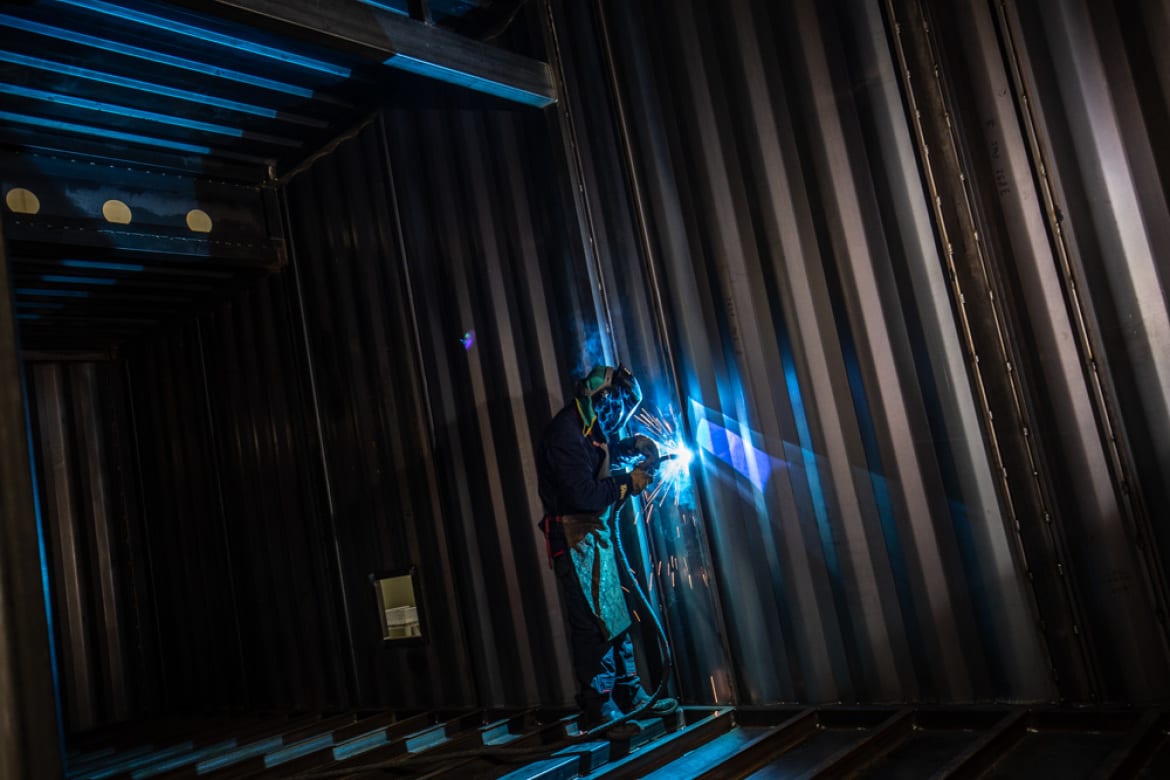
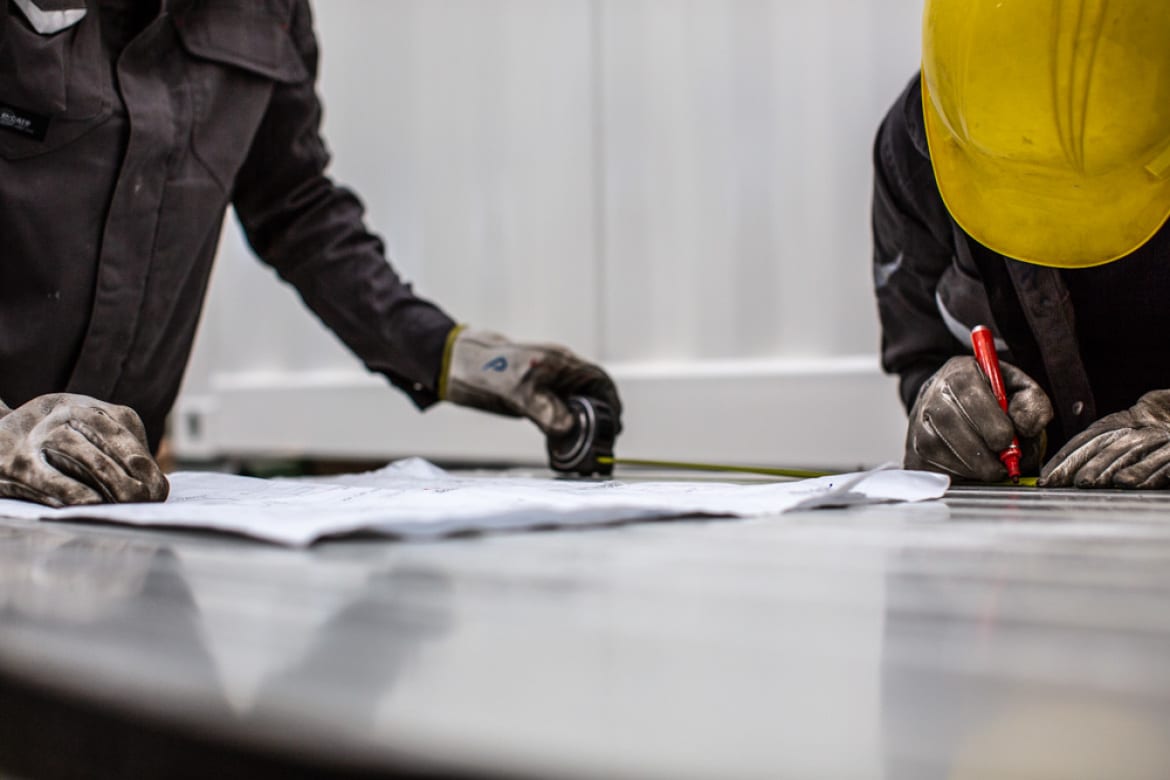
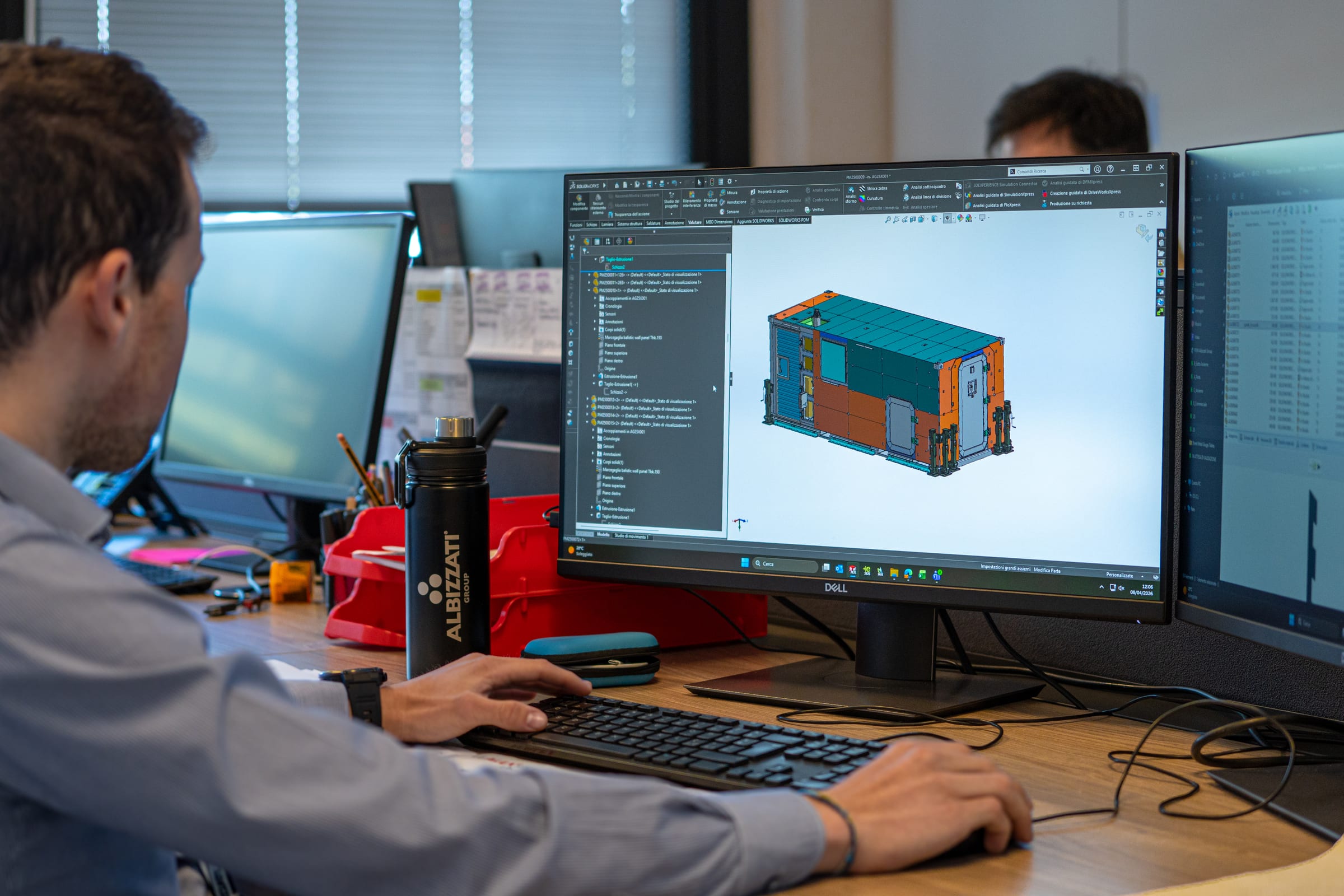
Customisation only works if engineering and manufacturing speak to each other every day. In our model they belong to the same group. Albizzati International Project develops the 2D and 3D design, FEM and CFD analysis and the structural, thermal, aeraulic and acoustic verifications; the production drawings go to the client for approval; the same engineers then follow fabrication, integration and testing. For a PCM passive shelter, for example, the thermal sizing is done with proprietary software that takes the site location, the day and night temperatures of the last 50 years and the heat dissipated by the equipment, and returns the exact quantity of phase change material and metres of finned pipe. The result is then proven in a four-day climatic chamber test that reproduces the site’s day and night cycle.
Customisation does not mean improvisation
Every custom product is built under the same certified systems: ISO 9001:2015 quality management, ISO 3834-2:2021 welding quality, EN 1090 for structural steel, CSA W47.1 for Canadian projects, the ASME U-Stamp for pressure vessels, MIL-STD and NATO standards for defence shelters. And every unit goes through the same test programme before delivery: dimensional, coating, electrical, functional, rain, load and drop, pressure, leak, weld inspection and thermal testing from −35 °C to +70 °C, followed by the factory acceptance test with the client. See our quality and certifications page.
What the client gains
- A product that fits the site, not a site adapted to the product
- Fewer field activities, because integration happens in the factory
- One accountable partner from specification to FAT
- Documentation, manuals and risk analysis specific to the project
Send us your specification, data sheet or mission profile: contact Albizzati Group.